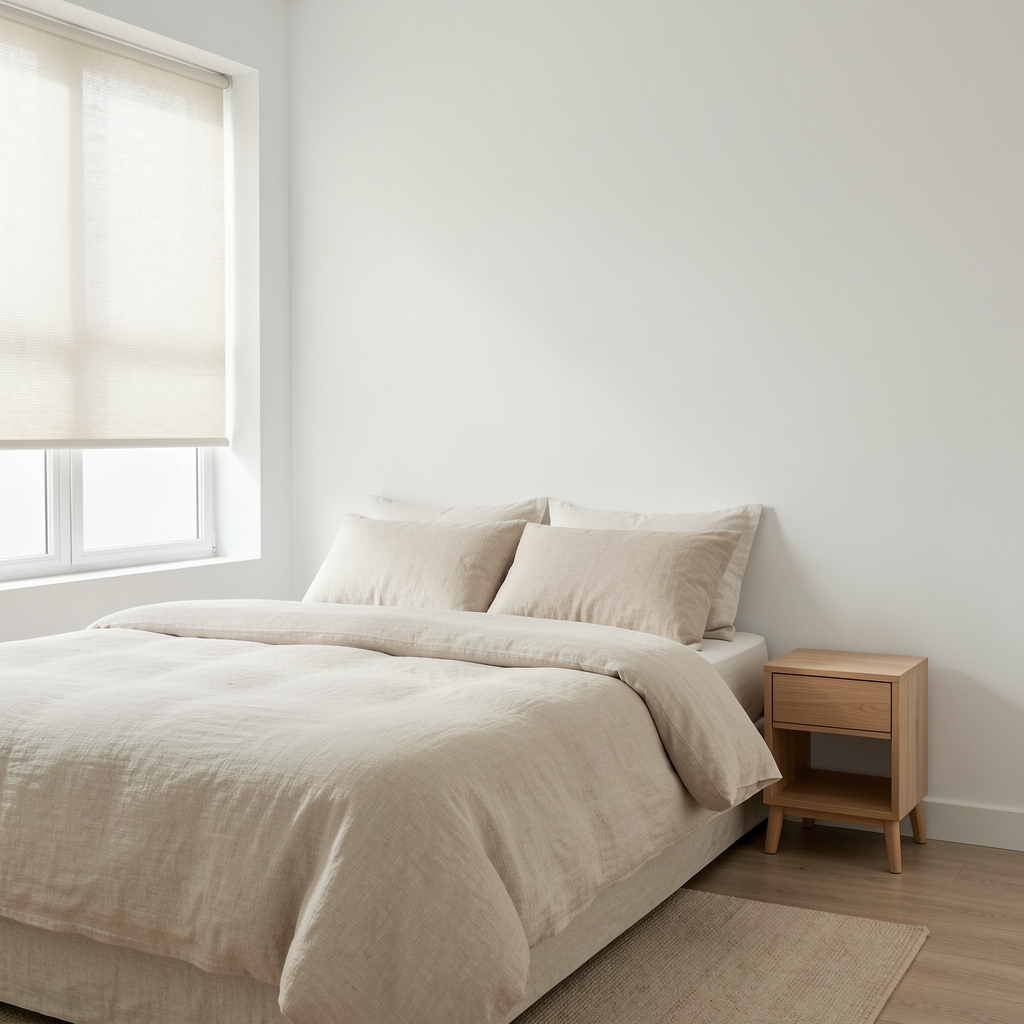
The environment in which sleep occurs is not a neutral backdrop. The human sleep system is attuned to a range of sensory inputs — light, sound, temperature, and physical comfort — and responds to each in ways that can either support or impede the onset and maintenance of rest. Understanding how these factors interact with the biology of sleep provides a useful complement to the structural account of sleep stages and circadian rhythms.
The Role of Light
Of all environmental factors, light has the most direct and well-characterised influence on sleep biology. As described in the article on circadian rhythms, the circadian clock is primarily entrained by the light-dark cycle. Light — particularly in the short-wavelength (blue) portion of the visible spectrum — acts as a powerful alerting signal that suppresses melatonin secretion and shifts the timing of the circadian phase.
The implication for the sleeping environment is that the transition from light to darkness in the hours preceding sleep onset is a biologically meaningful signal. Environments that maintain high ambient light levels into the late evening — whether through large uncovered windows, bright overhead lighting, or the proximity of illuminated screens — provide a continuous input that runs counter to the circadian signal for sleep. The specific effects depend on the intensity, wavelength, timing, and duration of light exposure, all of which vary considerably across real-world conditions.
Conversely, total darkness during sleep hours reduces the likelihood of sleep disruption caused by visual stimuli and helps maintain the melatonin signal across the night. The degree to which individual sleepers are affected by light intrusion during the night varies, but the general principle — that darkness supports the nocturnal phase of the circadian cycle — is broadly supported in the sleep science literature.
Sound and Acoustic Environment
The sleeping brain is not insensate to sound. Even in deep sleep, the auditory system continues to process incoming stimuli and generate responses to sounds that the cortex interprets as potentially significant. This is why sudden or unfamiliar sounds are more reliably arousing than continuous background noise — the brain's arousal system appears to be calibrated to novelty and significance rather than absolute sound level.
Continuous, predictable background noise — often described as "white noise" or "pink noise" in popular discourse, though these terms refer to specific spectral properties — has been examined in several research contexts as a potential moderator of acoustically disrupted sleep. The general principle is that a stable, low-level sound field may reduce the salience of superimposed transient sounds and, in some frameworks, be associated with reduced arousal frequency. However, the breadth of individual variation in sensitivity to ambient sound is considerable.
From a historical perspective, the acoustic environment of sleep has changed substantially over the past two centuries. The emergence of urban environments, internal combustion transport, and the increasingly continuous operation of industrial and commercial activity has introduced a range of acoustic features into sleep spaces that would have been largely absent in pre-industrial settings. How the sleep system adapts to — or is affected by — sustained exposure to elevated nocturnal noise remains an active area of environmental and physiological inquiry.
Temperature and Thermal Regulation
Core body temperature follows a circadian pattern, typically reaching its daily minimum in the hours before and during sleep. This drop in core temperature appears to support sleep onset and the maintenance of slow-wave sleep. The ambient thermal environment interacts with this process: a room that is too warm can impede the necessary heat dissipation from the body's core, while a very cold environment may trigger thermoregulatory arousal responses that disrupt sleep continuity.
The thermal comfort range associated with sleep in most adult populations is generally described as somewhat below typical waking comfort temperatures, though precise preferences vary significantly between individuals and are also influenced by factors such as bedding material, body composition, age, and prevailing climate. The key physiological point is that the relationship between core temperature and sleep is not incidental — it reflects an active biological process in which the sleeping environment plays a supporting or opposing role.
A Brief History of the Sleep Environment
Sleep commonly occurred in communal arrangements, with little deliberate separation of the sleep space from other daily activities. Light exposure was governed almost entirely by natural cycles, and acoustic environments were shaped by natural soundscapes and intermittent social activity.
Industrialisation brought shifts in domestic spatial organisation. The dedicated bedroom emerged as a social and architectural convention in urban middle-class contexts, separating sleep from communal living to a degree previously uncommon in much of the population.
The widespread adoption of electric lighting in the late 19th and early 20th centuries fundamentally altered the relationship between light and sleep timing. For the first time, sustained, bright artificial light was available throughout the evening, enabling — and often encouraging — later sleep times.
The proliferation of screens with high short-wavelength light output has extended light exposure further into the night than even mid-20th-century patterns. The acoustic environment has similarly intensified in most urban settings, creating a sleep context substantially different from that of any prior era.
Physical Comfort and the Role of Bedding
The physical surface and coverings used during sleep contribute to the thermal regulation discussed above and to a broader sense of physical comfort that influences sleep onset. Pressure, support, and tactile qualities of bedding interact with the body's postural adjustments during sleep — of which there are typically many across a night, though most occur without full awakening. The question of optimal bedding characteristics is largely individual and is also influenced by factors such as age-related changes in pressure sensitivity and circadian temperature patterns.
The Concept of a Dedicated Sleep Space
A concept that appears across multiple frameworks of sleep hygiene — the informal term for a set of environmental and behavioural practices associated with sleep quality in research literature — is the use of the sleeping environment exclusively or primarily for sleep. The reasoning, grounded in learning theory, is that the consistent pairing of a specific environment with the physiological state of sleep may strengthen the associative link between the two, facilitating the transition into sleep when the environmental cues are present.
This is a concept, not a prescription, and the degree to which it is practically relevant varies with living circumstances, cultural context, and individual variation. It is mentioned here as an illustration of how environmental and behavioural dimensions of sleep are interconnected in the existing conceptual frameworks, rather than as a directive.